

Surf etiquette is the set of unwritten rules that keep a crowded lineup safe and fair. The single most important one: never drop in on a wave someone is already riding. Right of way belongs to the surfer closest to the breaking part of the wave, the peak, and everyone else waits their turn. Learn these rules and the lineup welcomes you; ignore them and it will not.

This is a professional surfer’s guide to the rules of the lineup, written by Luis Perloiro, who teaches beginners the etiquette in the water every week at Carcavelos near Lisbon. It covers right of way, dropping in, snaking, how to paddle out, where beginners belong, and how to handle a mistake, so you can share waves with confidence rather than fear.
Recommended tour
PRIVATE SURF LESSON
Join a 3.5-hour private surf session at Carcavelos Beach, with daily departures from Hard Rock Café at 9 A.M. Enjoy guidance from a professional surfer (Luis Perloiro), transport in an A.C. van, surf gear, and a final drink at Tricana Beach Bar. Max: 8 people. Intensity: 7/10.
See dates & book →What is surf etiquette, and why it matters
A surfboard is heavy, has sharp fins, and travels fast. In a busy lineup, the rules of etiquette are what stop it becoming dangerous, and they are also what make wave-sharing fair. They are not snobbery; they are safety and courtesy rolled into one, and every surfer, from a first-timer to a pro, is expected to follow them.
The good news is that the core rules are simple and mostly common sense. Knowing them is what turns a nervous beginner into someone the locals are happy to share a peak with.
The rules of the lineup
These are the canonical rules, in roughly the order they matter.
| Rule | What it means |
|---|---|
| Right of way | The surfer closest to the peak has priority. One surfer per wave. |
| Do not drop in | Never take off on a wave someone with priority is already riding. |
| Do not snake | Do not keep paddling around others to steal priority you have not earned. |
| Paddle out wide | Go out through the channel, not through the lineup or in front of riders. |
| Never ditch your board | Hold on to it. A loose board is a danger to everyone behind you. |
| Communicate | On a peak that breaks both ways, call “left” or “right” so two can share it. |
| Respect the lineup | Wait your turn, do not wave-hog, and respect the locals who surf there daily. |
The golden rule: do not drop in
Dropping in is taking off on a wave when someone already riding it has the right of way. It is the number one offence in surfing, and it is dangerous: the surfer with priority is coming down the line at speed and often cannot see you until it is too late. If a wave is already being ridden, let it go and wait for the next one.

Right of way is decided by who is closest to the peak, the part of the wave that breaks first. That surfer gets the wave. On a peak that breaks in both directions, two surfers can split it, one going left and one going right, as long as they communicate first.
Paddling out without getting in the way
When you paddle back out, it is your job to stay clear of surfers riding waves. Paddle out through the channel, the area where waves are not breaking, rather than straight through the lineup. If a rider is coming towards you, paddle behind them, towards the white water, never in front. Taking a wave on the head is always better than ruining someone’s ride or causing a collision.
Where beginners belong
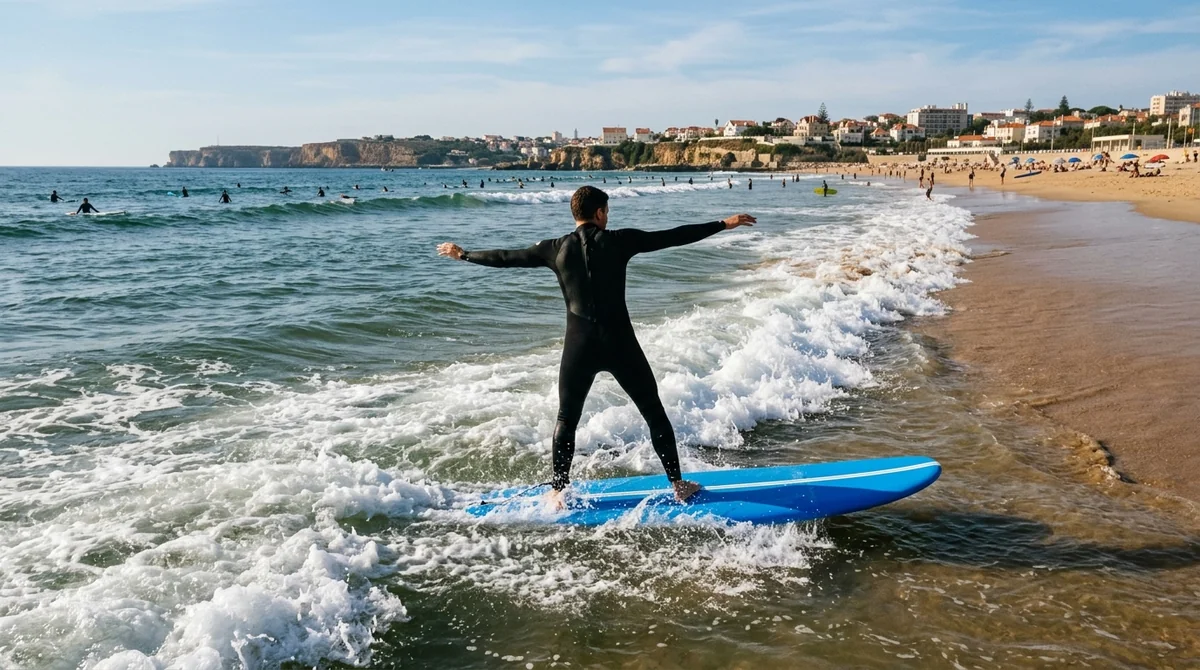
As a beginner you should be learning in the white water, the broken foam closer to shore, well away from the main peak where the experienced surfers sit. This is safer for you and for them, and it is where you will catch the most waves anyway.
If you break a rule
Everyone makes mistakes, especially early on. If you accidentally drop in on someone or get in their way, the fix is simple: a quick, sincere apology. A friendly “sorry” almost always defuses the situation. What frustrates surfers is not the mistake itself but a beginner who does not acknowledge it and keeps doing it.
Learn the lineup the safe way
Etiquette is far easier to learn with someone in the water beside you, calling your waves and positioning you correctly, than by trial and error in a crowd of strangers. A lesson lets you internalise right of way and drop-in avoidance without the pressure or the judgement.
On our beginner lesson at Carcavelos, Luis keeps you in the safe zone, tells you which waves are yours, and teaches the lineup rules as you go, so you come away confident enough to surf a busy beach on your own. Our full how to surf guide and our Carcavelos surf guide, along with our guide to surfing in Lisbon, cover the rest.
Recommended tour
PRIVATE SURF LESSON
Join a 3.5-hour private surf session at Carcavelos Beach, with daily departures from Hard Rock Café at 9 A.M. Enjoy guidance from a professional surfer (Luis Perloiro), transport in an A.C. van, surf gear, and a final drink at Tricana Beach Bar. Max: 8 people. Intensity: 7/10.
See dates & book →Frequently Asked Questions
What is surf etiquette?
Surf etiquette is the set of unwritten rules that keep a lineup safe and fair when many surfers share the same waves. The core rules cover right of way, not dropping in on other surfers, paddling out without getting in the way, holding on to your board, and respecting the locals and the order of the lineup.
Who has the right of way when surfing?
The surfer closest to the peak, the part of the wave that breaks first, has right of way and gets the wave. Everyone else must wait or pull back. On a wave that breaks in both directions, two surfers can split it, one going left and one right, provided they communicate before taking off.
What does dropping in mean in surfing?
Dropping in means taking off on a wave that someone with right of way is already riding. It is the most serious breach of surf etiquette and is dangerous, because the surfer with priority is travelling at speed and may not see you. If a wave is already being ridden, let it go and wait for the next one.
What is snaking in surfing?
Snaking is repeatedly paddling around or behind another surfer to position yourself closer to the peak and claim priority you have not earned. It is considered rude and disruptive. The polite approach is to wait your turn in the rotation rather than constantly manoeuvring to jump ahead of others in the lineup.
Where should beginners sit in the lineup?
Beginners should stay in the white water closer to shore, away from the main peak where experienced surfers sit. It is safer for everyone and you catch more waves there anyway. If you do move outside, sit on the edge of the pack rather than in the middle, and give riders plenty of room.
Should you ever ditch your board?
Avoid it whenever possible, especially near other people. A ditched board becomes a fast-moving projectile on the end of your leash and can seriously injure someone behind you. Learn to hold your board, turn it, and push through or duck under white water instead of throwing it away and diving off.
Respect the ocean, respect each other
Surf etiquette comes down to one idea: share the waves safely and fairly. Know who has right of way, never drop in, keep control of your board, and stay humble as a beginner, and you will be welcome in any lineup. The easiest way to learn it is in the water with a coach, on a beginner lesson at Carcavelos with Luis.





-

FULL DAY PRIVATE TOUR - WINE TASTING + SESIMBRA & ARRÁBIDA NATIONAL PARK
From €95.00 per personBook Now